How to Create a Productive Home Office in a Spare Bedroom
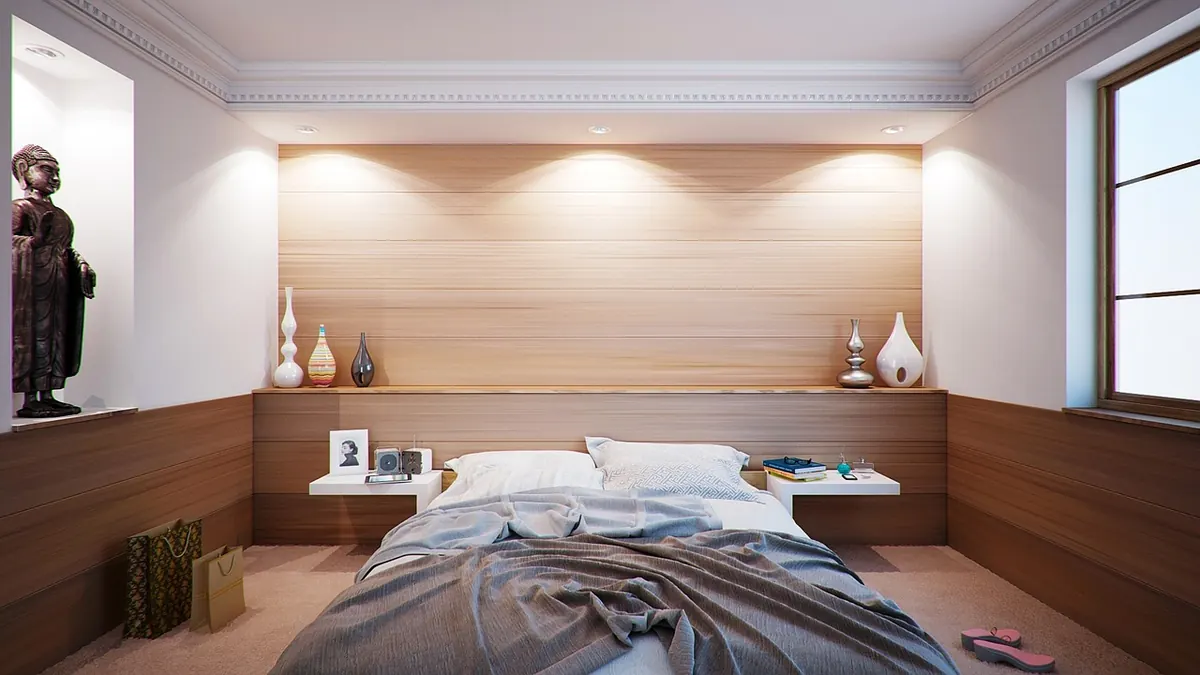
A spare bedroom is a difficult room to ask a lot of. It has to be quiet enough for a Monday morning call and restful enough that you can close the door on it at six o'clock. Most are small: one window, often a built-in cupboard, and a door that swings into the best corner. The answer isn't finding more space. It's giving each activity its own patch and stopping the furniture from competing for the same square metre. Get the zones right and a room of roughly 2.5m by 3m will hold a desk, a bed and a wardrobe without anyone feeling wedged in.
Take a tape measure, a pencil and a sheet of graph paper. Draw the room to scale and mark the fixed points you can't move: door swing, radiator, window sill height, socket positions, ceiling height, the depth of the wardrobe. Then walk the route you'd take on a normal working day — door to chair, chair to shelf, shelf to window. If two of those routes cross the bed, you'll be shuffling sideways by week two.
A few dimensions are worth keeping in mind. A desk around 60cm deep gives you room to sit a monitor at a comfortable distance. Allow roughly 75cm of clear floor behind the chair so you can push back without hitting anything. If you want a shelf above the desk, leave at least 45cm between the work surface and the underside of the shelf, or you'll block the light and bang your head on it. Treat these as minimums, not targets — the more clear surface you can give yourself, the less notice you'll take of the walls.
Work zone. Put the desk side-on to the window rather than facing it. You get daylight across the desk without the screen glare that comes from sitting with the window behind you or directly ahead. If the only sensible spot is facing a wall, hang something at eye level and add a lamp — a blank wall six inches from your nose gets old quickly.
Storage zone. Group it near the door, where you arrive and leave. That's where a coat, a bag and a box of paperwork naturally land. Deep storage against the wall behind the door works well because the door swing already rules that corner out for anything else.
Rest zone. Keep the bed away from the desk. Even a metre of separation helps your brain read the two areas as different places. If the room doubles as a guest room, the bed goes in the least-used corner, furthest from the door.
The bed is usually the awkward item. A single bed pushed along a wall takes less visual space than a double with clearance on both sides, and it frees the opposite wall for the desk. If guests matter more than day-to-day comfort, a decent sofa bed or a daybed with a firm mattress works — but be honest about how often it will be unfolded. A bed that lives half-open is the fastest way to make the room feel cramped.
For the daytime version, treat the bed as seating. Two cushions, a throw folded at the foot, and a made bed rather than a rumpled duvet change how the room reads from the doorway. It sounds like a small thing. It's the difference between "office with a bed in it" and "room that works".
Clutter eats more space than furniture does, because it spreads. Give every category of object a specific home and put it there at the end of the day.
The rule that matters: nothing lives on the desk overnight except what's in that tray. If there's no home for something, that's the signal to sort it, not to start a pile.
One ceiling light in the middle of a bedroom is tiring to work under. Layer it. A desk lamp for tasks, a softer lamp behind you or in the corner, and the overhead on only when you need it. Warm bulbs for the evening, brighter and cooler for work. If you spend hours on video calls, a small light aimed at the wall behind your screen lifts your face without glare.
Sound is the other thing people forget. Hard floors and bare walls make a small room echo, which is why calls sound hollow and tiring. A rug, a curtain, a shelf of books and a soft chair absorb some of it. A draught excluder or seal around the door cuts household noise more than you'd expect. If the room still carries sound, close the door and use a headset rather than speakers.
The room only works if you can leave it. A short end-of-day routine does most of the heavy lifting: laptop into a drawer, desk wiped and cleared, chair pushed in, blind adjusted. Two minutes, every day, no exceptions.
If you can manage a physical divider, even better. A low bookcase, a folding screen or a curtain on a ceiling track across the room gives you a visual break without a wall. If the room is shared — with a partner, or a child who sleeps there — agree the working hours in advance and put them somewhere visible.
Small rooms reward restraint. A clear desk, one good lamp and a bed you can close the door on will serve you better than a clever storage system you never quite finish filling.
Photo: keresi72 / Pixabay
Previous Post
Common Mistakes to Avoid When Buying a Home Office Chair in the UK
Next Post
Desk Setups for Video Calls: How to Look Professional in a Small Space