Office Views: How to Improve Your Background When You Have No Window
No window? You are in decent company. Spare rooms, box rooms, the narrow space beside a boiler — the best desk in the house often ends up in the one room that never got a view. The difficulty is not really the light. Light you can fix with a lamp. It is the sameness. A window gives your eyes somewhere to travel and your attention somewhere to rest for a second; a flat magnolia wall gives you neither. Everything a window does — depth, colour, something that shifts — can be arranged, grown or lit instead.
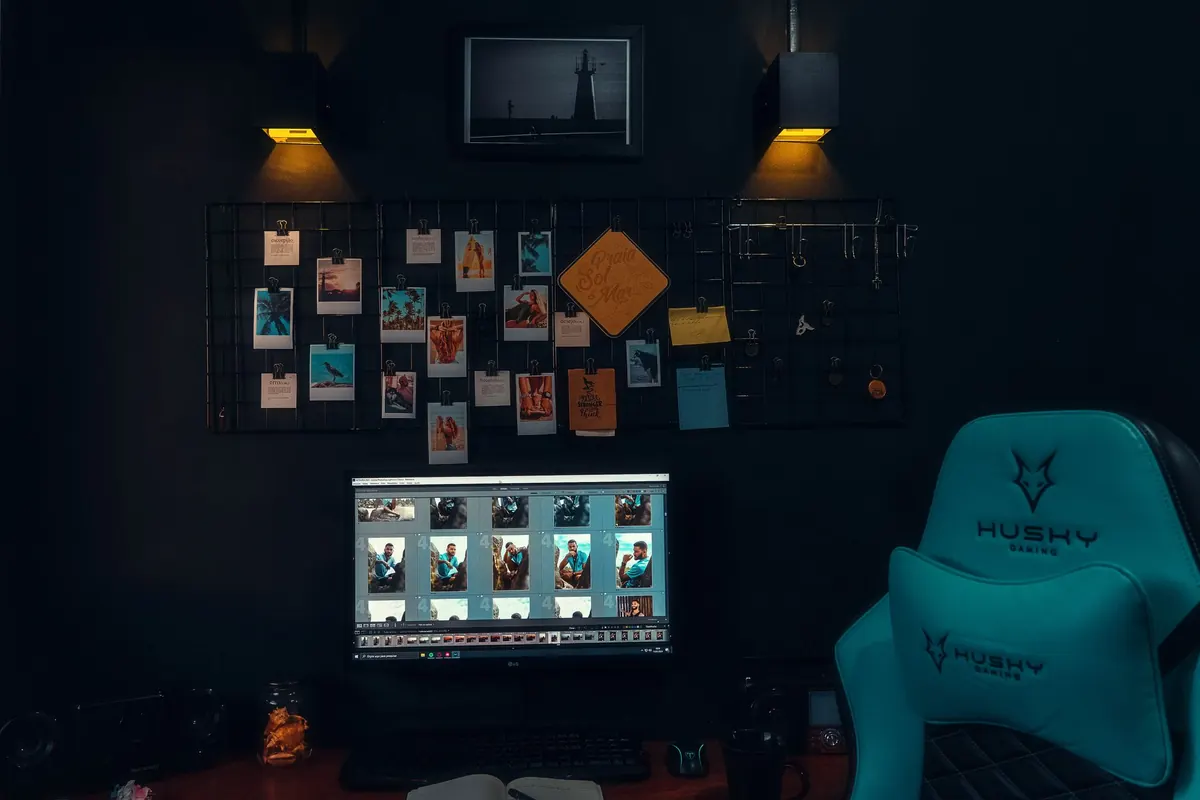
When four walls are painted the same flat white, the room reads as a box, and your brain notices the box. Choose one wall — ideally the one you face, or the one the camera sees — and give it something to do. A mid-tone colour such as a deep green, a soft blue or a warm clay adds a sense of distance. So does texture: a slat panel, a large cork board, a hanging textile, or a length of removable wallpaper if you rent and cannot paint.
Keep the change to one wall. Two or three will close the room in rather than open it out. If you are painting, a ceiling a shade lighter than the walls keeps the space feeling taller, while a dark ceiling brings it closer — cosy in the right room, claustrophobic in the wrong one.
Sit at your desk and look straight ahead. What you want at roughly eyeline is a horizontal line, doing the same job a horizon does outdoors. A long shelf across that wall does it neatly. So does a row of framed prints at a consistent height, or a picture ledge. The line is the point; the objects are the decoration.
Then style it with restraint. A shelf packed edge to edge stops reading as a horizon and starts reading as a wall of stuff.
Be realistic: no houseplant loves a windowless room. The tolerant ones — snake plant, ZZ plant, cast iron plant, pothos, peace lily — cope with low light rather than enjoy it. Plan around that.
Rotate. Keep two or three plants on the shelf and move them into a brighter room every few weeks, bringing others back in their place. It takes a minute and keeps everything alive. A small timer-controlled lamp above the shelf helps too, and doubles as accent lighting in the evening.
If rotation is never going to happen, good-quality artificial plants are a legitimate choice. Buy fewer and better: one convincing plant beats five that look plastic from across the room. A dried arrangement — eucalyptus, dried grasses, seed heads — needs no light at all and never droops.
The classic windowless-office mistake is one bright lamp aimed at the keyboard. Your work surface is lit, everything else is gloom, and the room feels like a cave with a reading light.
Spread the light out instead. Aim for three sources at different heights: a desk lamp, a floor lamp or corner uplight, and something small and warm on the shelf. Point at least one of them at a wall. Light bouncing off a pale surface reads to the eye much more like daylight than a bulb aimed straight at your face. Keep the bulbs in the warm range unless you need cool light for colour-critical work.
An uplight in the corner is the single most effective change in a small room. It throws a pool of light up the wall and across the ceiling, which lifts the whole space and makes the ceiling feel higher than it is. If headaches or sore eyes persist after long screen days, that is worth raising with an optician rather than solving with another lamp.
On a call, only about a metre of your room is on show. That is a small problem to solve, and worth solving properly.
The best video backgrounds are simple and slightly uneven: a shelf with a few books and one plant, a framed print, a wall with a bit of texture. A completely blank wall reads like a passport photo. Doors, beds, laundry and tightly packed open shelving are best avoided — not because they look bad in life, but because they pull the eye away from you.
Angling the desk slightly towards a wall rather than sitting square-on to it also gives the camera an interesting diagonal instead of a flat plane.
Blur and virtual backgrounds are a fallback, not a decorating plan. Use them when the room is shared, when you are working from a kitchen table, or when you are between setups and nothing is settled yet.
They work best when your real background is already fairly plain. A patterned or cluttered wall confuses the edge detection and you end up with a faint halo around your shoulders. Even, soft light on your face helps as well. If you do use one, pick something calm and static; a moving background is distracting for everyone on the call, including you.
Once a week, sit down at the desk, look up and take stock. Do you see anything at eye level that is not a wall? Is there one thing in front of you worth looking at?
If the answer is no, change one thing: move a print, add a second lamp, bring in a plant. Rotate a single object on the shelf, wipe the leaves, tidy the cables that have crept into camera range, and recheck your framing if anything has shifted. Small, regular adjustments beat one big makeover, and they cost you minutes rather than a weekend.
The aim is not to pretend there is a window behind you. It is to make sure that when you lift your eyes from the screen, the room gives something back.
Photo: Lucas Andrade / Pexels
Previous Post
The Seasonal Workspace Reset: Preparing Your Home Office for Autumn and Winter
Next Post
Cable Management for Home Offices: A Step-by-Step Guide to a Tidier Desk